The 2025 Social Media Trends That Actually Mattered (and the Playbook to Operationalize Them in 2026)
Social media is not “just a channel” anymore, and 2025 made that impossible to ignore. This year, social didn’t simply shape brand perception. It shaped demand planning, customer service queues, creator contracts, and the accuracy of your revenue forecast. When a platform can go dark and come back before lunch, your social strategy starts looking a lot like risk management.
That “one day” TikTok ban moment in January was the perfect example. Even if your team had contingencies, the emotional whiplash forced a hard question: if our biggest distribution engine gets kneecapped overnight, how many other parts of our business break with it? Built In
And the stakes are not getting smaller. The global social media user base is now well into the billions, and social platforms keep absorbing more of consumers’ daily attention, discovery behavior, and shopping intent. DataReportal – Global Digital Insights
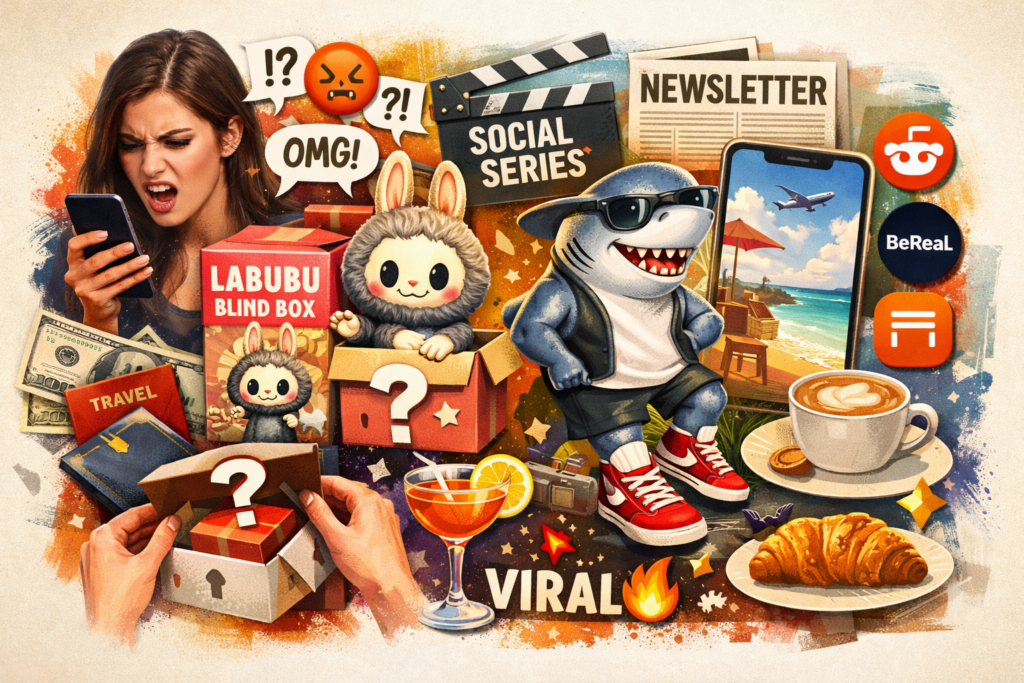
Marketing Brew’s year-end recap captured the vibe well: rage-inducing discourse, “brain rot” content, Labubu unboxings, vertical scripted series, and brands experimenting with newer frontiers like Substack, Reddit, BeReal, and Instagram broadcast channels. Marketing Brew
Below is a wrap-up of the trends that really moved the game in 2025, plus the “how to” that matters for experienced marketers who want to tighten execution and avoid stepping on rakes in 2026.
1) Rage became a growth lever (and a brand safety minefield)
If you felt like the internet was more combustible this year, you were not imagining it. Oxford University Press named “ragebait” its Word of the Year for 2025. Oxford University Press
Marketing Brew called out a pattern marketers saw all year: campaigns that sparked anger, debate, or disbelief often got rewarded with reach and comment velocity. Sometimes the controversy was engineered. Sometimes it was a self-inflicted wound. Either way, engagement spiked, and the algorithm took that as a signal to distribute harder. Marketing Brew
What changed in 2025:
Rage stopped being an accident. It became an accelerant brands could predictably trigger. The problem is that “predictable reach” and “predictable outcomes” are not the same thing.
How to operationalize it without torching the brand:
- Build a provocation rubric (yes, literally a rubric).
Your team needs a shared language for the difference between:- Playful controversy (banter, culturally fluent takes, light stakes)
- Polarizing controversy (identity, politics, sensitive news contexts)
- Product controversy (pricing, claims, safety, quality)
Decide in advance what categories you are willing to touch, and what is a hard no.
- Instrument comment quality, not just volume.
If you only track engagement rate, ragebait will look like a miracle. Add signals like:- share-to-comment ratio (often cleaner than comment spikes)
- save rate (usually indicates intent vs outrage)
- brand sentiment delta in the 24–72 hours after posting
- customer care escalation volume tied to the post
- Treat bot amplification as a plausible factor, not a conspiracy theory.
Marketing Brew flagged the growing weirdness of social, including the way bot networks can amplify controversy. Marketing Brew
The practical takeaway is simple: when backlash seems unusually fast or unusually coordinated, do not assume the comment section is a representative sample of customers. Validate with first-party signals (site search terms, support tickets, conversion rate changes, retail feedback).
If you want a clean internal reference point for your broader social operating model, Hawke’s social media services overview lays out the real work behind the scenes: community management, brand voice consistency, content distribution, and reporting. (Link for your team: https://hawkemedia.com/services/social-media/). Hawke Media
2) “Brain rot” content matured into a real brand asset (when done with discipline)
The internet stayed weird, and for many brands, weird worked. Marketing Brew described a year full of nonsense edits, brand lore, and “unserious” content that made sense if you were in the community and felt like chaos if you were not. Marketing Brew
Oxford’s 2024 Word of the Year was “brain rot,” and Oxford later added the term to the Oxford English Dictionary, noting its spike in usage and its connection to online culture. Oxford University Press
In other words, “brain rot” stopped being a throwaway insult and became a recognized cultural label for the kind of low-stakes, high-frequency content people binge anyway.
What changed in 2025:
Brands learned they can earn attention by being entertaining without being useful, as long as they are consistent characters in the feed.
How to build “unhinged” content without becoming incoherent:
- Create a brand character bible.
Not a tone-of-voice doc that says “we’re playful.” A real guide:- what the brand “believes” (even if it’s silly)
- what it refuses to joke about
- recurring bits and callbacks
- how the brand responds when it is wrong
- Design content as episodic, not isolated.
Brain rot content performs when it creates anticipation. The tactic is not “post random weirdness.” The tactic is “teach the audience how to watch you.” - Protect the conversion layer.
The best version of this trend is when top-of-funnel chaos does not infect your product truth. Your PDPs, ads, and email flows still need clarity. Otherwise you win attention and lose trust.
Hawke has a practical framing that pairs well with this: build a consistent social foundation, then scale experiments. (Useful internal link: https://hawkemedia.com/insights/how-to-build-your-brand-on-social-media/). Hawke Media
3) The unboxing economy exploded, and “going in blind” became a format
If 2025 had a mascot, Marketing Brew argued it might be Labubu, the “blind box” collectible that flooded feeds via unboxings. Marketing Brew
The business side of that trend is not small. Reuters reported Pop Mart’s CEO expected the company’s revenue could exceed 30 billion yuan (about $4.18B) in 2025, driven by demand for characters like Labubu in “The Monsters” line. Reuters
Wired also documented how Labubu’s popularity contributed to major growth, including surging plush revenue and a scarcity dynamic that fueled resale and counterfeits. WIRED
What changed in 2025:
Unboxing was no longer just “influencer content.” It became a repeatable, algorithm-friendly narrative structure: suspense → reveal → reaction → comparison → “which one did you get?”
How to use the format even if you do not sell collectibles:
- Engineer “reveal moments” into product and packaging.
The unboxing camera is ruthless. If the experience is flat, the content is flat. Build tactile steps, visual reveals, or included surprises that are cheap for you and delightful on camera. - Seed formats, not posts.
Instead of briefing creators with “make an unboxing,” give them three distinct angles:- ASMR version (sound, texture, close-up)
- review version (pros and cons, use case)
- chaos version (funny, unexpected, memeable)
- Make “inventory planning” part of the creative plan.
Here is the non-obvious lesson from Labubu: scarcity can drive demand, but accidental scarcity breaks trust. If a UGC-driven spike would wipe out stock, plan a waitlist flow and a replenishment narrative in advance.
If your team wants a refresher on how UGC fits into trust-building, Hawke’s piece on why user-generated content is “more important than ever” is a solid anchor: https://hawkemedia.com/insights/why-user-generated-content-will-be-more-important-than-ever/.
4) Social became episodic entertainment, and brands started acting like studios
Marketing Brew highlighted the rise of scripted social series and brand-led story worlds: micro-dramas, creator-style shows, and reality TV energy rebuilt for vertical. Marketing Brew
This is not just “make a series.” The deeper shift is operational: brands started staffing social like production.
What changed in 2025:
A single viral post stopped being the aspiration. Repeatable programming became the aspiration.
How to build a series that performs like content, not like an ad:
- Run a writer’s room, even if it’s lightweight.
You need a weekly cadence where you pitch episodes, map arcs, and assign roles. The moment you treat each post like a one-off, the series dies. - Use the showrunner model.
One person owns consistency across:- characters (who appears, how they behave)
- pacing (how fast the series moves)
- canon (what is “true” in the brand world)
- Measure series health differently.
Evaluate:- return viewer rate (repeat commenters, repeat likers)
- episode-to-episode drop-off
- follower growth velocity on posting days
- conversion lift from people who watched 2+ episodes
5) Platform diversification got serious: BeReal, Reddit, Substack, broadcast channels
This year’s TikTok uncertainty pushed marketers to stop treating diversification as a slide in a deck and start treating it as a real budget decision. Built In
Marketing Brew noted brands exploring Substack, leaning into Reddit for social listening and conversation, experimenting with BeReal again, and using Instagram broadcast channels to reward engaged customers. Marketing Brew
Some of those “new frontiers” also started to mature commercially. Marketing Dive reported BeReal launched its US advertising platform in 2025 and said the platform had over 40 million monthly users globally, along with early advertiser participation that included brands like Levi’s, Nike, and Amazon. Marketing Dive
Meanwhile, Reddit’s own investor release reported Daily Active Uniques (DAUq) reached 116.0 million in Q3 2025, with revenue up 68% year over year to $585 million. Reddit Investor Relations
What changed in 2025:
Brands realized “social” is not synonymous with “the big three apps.” It’s any place people gather to trade opinions, recommendations, and identity.
How to approach these channels without looking like a tourist:
- Reddit: prioritize listening and utility.
Start with social listening, pain-point mining, and trend validation. Then earn participation through helpful content, founder presence, or transparent AMAs. If you lead with promotion, you will get rejected by the culture. - Broadcast channels: treat them like VIP messaging lanes.
The point is not reach. The point is retention. Use them for early drops, behind-the-scenes, and community rewards that make your most engaged customers feel “in on it.” - Substack and newsletters: turn creators into partners, not just placements.
The opportunity is not “another email.” It is credibility through voice, especially when the writer’s audience trusts them more than it trusts brands.
If you want a clean TikTok strategy baseline while you diversify, Hawke has multiple resources worth circulating internally, including https://hawkemedia.com/insights/how-brands-can-get-started-on-tiktok-marketing/ and the TikTok capability overview at https://hawkemedia.com/tiktok/.
6) Economic anxiety showed up in content as “accessible luxury” and escapism
Marketing Brew’s framing here was sharp: as consumers felt squeezed, brands sold small indulgences and “little treats,” and some even leaned into physical experiences like coffee shops or trips to create lifestyle gravity. Marketing Brew
The marketing lesson is not “pretend everything is fine.” It’s that your audience’s emotional context is part of your creative brief. In a shaky economy, value is not only price. Value is also mood.
How to apply this without feeling tone-deaf:
- Validate reality, then offer the escape.
The copy and creative that landed best in 2025 often acknowledged stress implicitly, then delivered something light: humor, comfort, ritual, or community. - Pressure test “luxury signaling.”
If you are going to flex, do it with awareness. Big gestures can inspire, but they can also alienate. Watch comment sentiment and be ready to adjust fast.
The meta-trend behind all of this: social got more narrative, more volatile, and more operational
If 2024 was about scaling content, 2025 was about scaling formats that behave like culture. Ragebait, brain rot, unboxing, micro-series, new platforms, and accessible luxury all share one commonality: they are storytelling mechanics first, and marketing tactics second. Marketing Brew+2Oxford University Press+2
If you want to carry one practical shift into 2026, make it this: stop managing social like a calendar, and start managing it like a living system. That system needs guardrails, measurement that reflects reality, and a production engine that can respond quickly without losing the plot.
If you want, I can turn this into (1) a tighter executive summary for a newsletter send, (2) a 2026-ready checklist your team can use during planning, or (3) a version tailored to a specific vertical like DTC, SaaS, or retail.