The Ad Fatigue & Creative Refresh Timer
July 31, 2026
Stack-Gap Tools
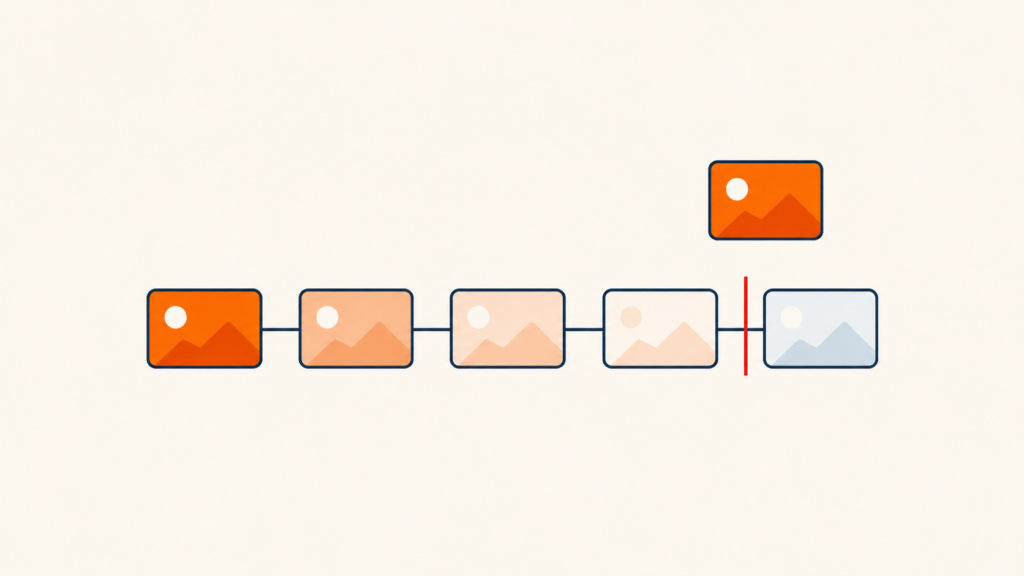
Media buyers know when an ad is tiring. They can feel it in the frequency number and the drift in click-through rate, and they usually act a week or two after they should have. This turns that judgement into a date. Enter frequency, click-through trend, and days live for each ad set, and it estimates when each creative hits its refresh point, what the delay is costing, and how many new concepts your account needs per month to keep up.
| Ad set / creative | Audience | Days live | Freq (7-day) | CTR launch % | CTR now % | Daily spend | CPM launch | CPM now | Audience size | Reach to date |
|---|
| Ad set / creative | Fatigue | Stage | CTR decay | Freq vs ceiling | Est. lifespan | Refresh in | Refresh by | Binding constraint | Confidence | Est. spend lost |
|---|
A refresh date is only useful if something ships
Most accounts do not have a fatigue problem, they have a production problem. A free 30-minute consultation covers what your account needs per month and how to actually produce it.
Free 30 minutes. Expert-matched.
| Ad set / creative | CTR | CPM | Freq | Saturation | Diagnosis and what to do |
|---|
How the estimate works. Click-through rate is modelled as exponential decay between your launch figure and your current figure, which gives a decay rate per day. Projecting that rate forward to your refresh threshold produces an estimated lifespan, and subtracting days live gives days remaining. Frequency is projected from an assumed starting point of 1.0 at launch to the ceiling for that audience type: 2.5 for cold prospecting, 3.2 for broad, and 6.0 for retargeting, all measured over a rolling 7 days. Audience saturation, where you supply audience size and reach, projects forward at the observed daily reach rate to a 65% saturation ceiling. Whichever of those three arrives first is the binding constraint and sets the refresh date. The fatigue score weights CTR decay at 35, frequency load at 25, CPM inflation at 15, audience saturation at 15, and time in market at 10, rescaled to 100 across whichever components you have supplied data for. Estimated spend lost multiplies daily spend by days past the refresh point by the proportional CTR decline, which approximates the efficiency you are no longer getting. Every figure here is a projection from two data points and a decay assumption, so treat it as a scheduling aid rather than a forecast. Every calculation runs in your browser, and nothing you enter is uploaded, stored, or logged.
Get expert eyes on your creative pipeline
Hawke Media runs paid social, creative production, and lifecycle under one roof, so the refresh plan comes with the people who can make the assets. Bring your account to a free consultation.
Response within 1 business day.
Who this is for
This is for the person actually responsible for a Meta account: an in-house marketer, a founder buying their own media, or an agency team managing several brands at once. If you have ever looked at a frequency number and thought "that's getting high" without deciding what to do about it, this turns that instinct into a scheduled task.
It matters most for ecommerce and DTC brands spending consistently on prospecting, where creative is the main lever left. Targeting has largely been automated away, bid strategy is a short menu, and budget is whatever it is. What remains under your control is what the ad says and how often the same person sees it, which makes the rate at which creative wears out one of the few genuine performance variables in the account.
Why the refresh always happens late
Fatigue is gradual, and gradual problems lose to urgent ones every week. Nothing breaks on the day an ad starts declining. Click-through rate slips a few percent, then a few more, and cost per acquisition drifts up slowly enough to be blamed on seasonality, a competitor's promotion, or the weekend. By the time the decline is unmistakable in the cost per acquisition column, it has usually been running for two or three weeks.
The platform will not tell you either. Meta's own quality and relevance diagnostics report what has already happened rather than what is about to, and they will not tell you that an ad has eleven days left. There is no field anywhere in Ads Manager for the expected remaining life of a creative, which is precisely the number a buyer needs in order to brief a replacement in time.
Then there is the production lag. Even a team that spots fatigue immediately needs a brief, an edit, an approval, and an upload. If that takes ten days and the refresh point was yesterday, the account runs on tired creative for ten more days regardless of how quickly anyone noticed. The date that actually matters is not the refresh date. It is the refresh date minus your lead time, and that earlier date is the one nobody calculates.
Not all decline is fatigue. Three different problems look identical in the cost per acquisition column and need opposite responses. If CTR is falling and frequency is high, the audience is used up, and new creative into an exhausted pool decays faster than the original did. If CTR is falling while frequency stays low, repetition is not the cause, so a fresh edit of the same idea will land exactly the same way; the angle or the offer is what needs to change. And if CTR is holding while CPM climbs, that is the auction rather than your creative, and producing new assets spends the production budget on the wrong problem entirely. Reading these three apart is most of the skill.
Find out what your account is losing to late refreshes
Most accounts do not have a creative problem, they have a scheduling problem. Spend 30 minutes with a Hawke Media expert and get an honest read on your creative pipeline.
Talk To An ExpertFree 30 minutes. Expert-matched. Proposal only if it is a fit.
What the tool estimates
Enter days live, seven-day frequency, and click-through rate at launch against click-through rate now, and it fits an exponential decay curve between those two points to produce a decay rate per day. Projecting that rate forward to your refresh threshold, which defaults to the point where CTR has fallen to 70% of launch, gives an estimated lifespan for that creative and therefore a date.
Two other constraints run alongside it. Frequency is projected from an assumed 1.0 at launch to the ceiling for the audience type, which is roughly 2.5 impressions per person per week for cold prospecting, 3.2 for broad, and 6.0 or more for retargeting, where the audience is small, warm, and expects to see you. Where you supply audience size and reach, saturation is projected forward to a 65% ceiling. Whichever of the three arrives first is the binding constraint and sets the date, and the tool names which one it was, because the fix differs in each case.
Alongside the dates it produces two numbers worth putting in front of whoever controls the budget. The first is the spend already lost: daily budget multiplied by days past the refresh point multiplied by the proportional decline in engagement, which approximates the performance you are paying for and no longer receiving. The second is your required production rate, calculated from average creative lifespan and the number of ad sets you keep live. Most accounts that plateau are not out of budget or out of audience. They are out of creative, and the gap between the rate they need and the rate they produce is the entire explanation.
What to do with the answer
Check it weekly, not quarterly, and check it on a fixed day so it becomes a routine rather than a reaction. Work backwards from every refresh date by your production lead time and brief on that earlier date. Read the diagnosis before commissioning anything, because a third of the time the honest answer is to leave the creative alone and fix the audience or the offer instead. And treat the required-concepts-per-month figure as a real operating constraint with a budget attached, in the same way you treat media spend.
Every calculation runs in your browser. Nothing you type is uploaded, stored, or transmitted anywhere.
Frequently asked questions
What frequency is too high on Meta?
It depends on the audience, which is why a single threshold is misleading. For cold prospecting, a seven-day frequency above roughly 2.5 usually means you are re-serving the same people faster than the pool refreshes, and performance follows shortly after. Broad targeting tolerates around 3.2 because the delivery pool is much larger. Retargeting audiences comfortably run at 6 or higher, since they are small, already familiar with you, and expect repetition. Always use the seven-day figure rather than lifetime frequency: lifetime frequency only ever rises and tells you nothing about current pressure.
How often should Meta ad creative be refreshed?
There is no fixed interval, which is the reason for estimating it per ad set. In practice, cold prospecting creative on meaningful spend commonly runs three to six weeks before hitting a 70% CTR threshold, while retargeting creative in a small audience can fatigue in two and evergreen creative in a very large broad audience can last several months. Spend level is the biggest driver: the same creative at four times the daily budget exhausts its audience in roughly a quarter of the time. Measure it rather than assuming a calendar rule, because the rule that fits one account will be badly wrong for another.
What is the first sign of ad fatigue?
Click-through rate is the earliest reliable signal, because it responds directly to whether people still find the ad worth looking at, and it moves before cost per acquisition does. Rising frequency is the leading indicator behind it, since it explains why CTR is about to fall. Cost per acquisition is the last to move and the least useful for timing, because it is affected by landing page, offer, seasonality, and auction pressure at the same time. By the time CPA is obviously worse, the creative has usually been declining for two to three weeks.
Does new creative always fix fatigue?
No, and this is where most production budget gets wasted. If frequency is high, the audience is saturated rather than bored, and a new cut of the same concept will decay faster than the original did; the fix is a wider audience, refreshed exclusions, or a new placement. If CTR fell while frequency stayed low, repetition was never the cause, and the angle or the offer needs to change rather than the edit. If CTR is holding and only CPM has risen, that is auction pressure and has nothing to do with your creative at all. Diagnose before commissioning.
How accurate is the refresh date?
It is a projection from two data points and a decay assumption, so treat it as a scheduling aid rather than a forecast. Accuracy improves considerably once an ad set has been live two weeks or more on stable spend, which is why the tool reports a confidence level alongside each estimate. Anything under seven days is genuinely too early to project, and a mid-flight change to budget, audience, or placement resets the curve. The value is not the precision of the date. It is having a date at all, early enough to brief a replacement before performance is already gone.
Is my data sent anywhere?
No. Every calculation runs locally in your browser using JavaScript embedded in the page. Nothing you enter is transmitted to a server, saved to a database, or logged. Closing the tab clears it. To keep a record, use the CSV download or print to PDF; both are produced on your own device.