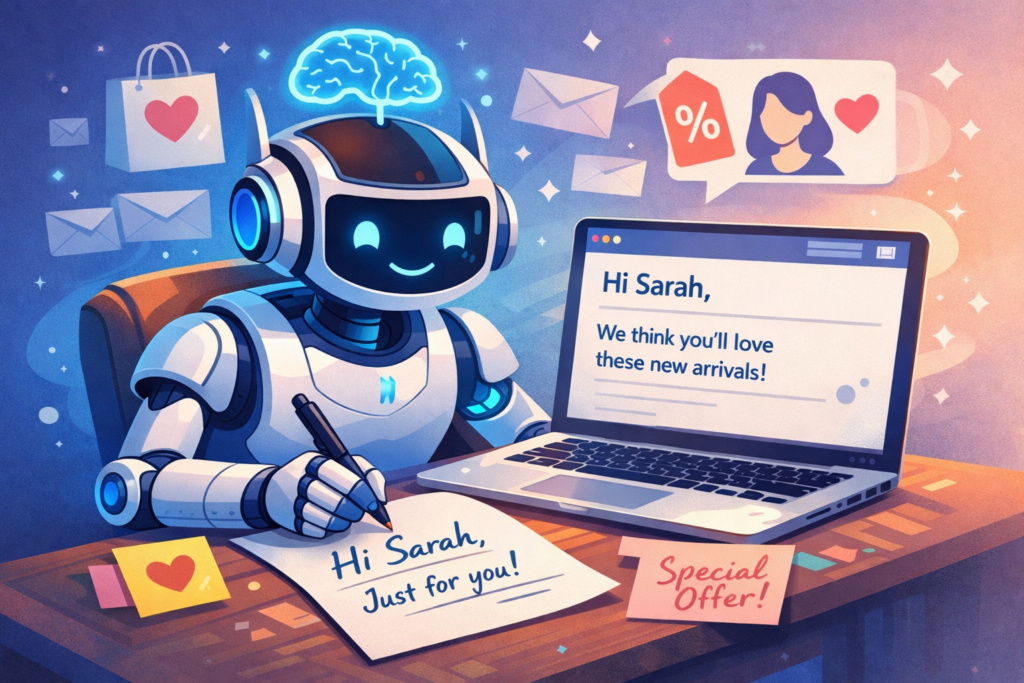
Why Most AI Personalization Feels Creepy, Broken, or Useless
A couple years ago, “personalization” meant swapping in a first name and praying your ESP didn’t merge “Hi {{first_name}}” into “Hi ,”. Now it’s tied to your margins, your inventory position, your customer support load, and whether your CMO has to explain to finance why CAC went up while conversion stayed flat.
AI personalization is not a vibe. It’s an operating system.
The best teams treat it like revenue infrastructure: a set of decisions that get made repeatedly, at speed, with guardrails. The worst teams treat it like a stunt: a shiny model sitting on top of messy data, spraying “personalized” experiences that feel generic, creepy, or both.
And customers notice. McKinsey has found that 71% of consumers expect personalized interactions and 76% get frustrated when they don’t receive them . At the same time, Gartner warns that 48% of personalized communications miss the mark and are perceived as irrelevant or intrusive. That is the knife edge you are walking on.
Let’s talk about what actually worked, what didn’t, and how to build a personalization program that feels human even when it’s powered by machines.
What worked
1) First-party data as the backbone (not a buzzword)
The teams who won with AI personalization did something unfashionable: they obsessed over boring plumbing.
They unified identity across platforms. They cleaned event taxonomies. They made consent and preference data usable. Then they used AI to decide what to do next, not to guess what happened.
This matters even more because ad tech continues to shift under your feet. Google has adjusted its approach to third-party cookies in Chrome, choosing not to roll out a new standalone cookie prompt and keeping cookie controls in existing settings, while continuing Privacy Sandbox work. Whether your organization is cookie-dependent or “cookie-resilient” shows up fast when targeting breaks, attribution gets foggy, and your “personalized” audiences suddenly look like mush.
Believable example:
A DTC brand with strong creative could not scale beyond prospecting because repeat purchase was lagging. Their “personalization” was basically “show recent products.” Once they fixed identity and event capture (viewed category, time-to-next-order, subscription status), they stopped chasing one-to-one fantasies and instead built three high-confidence states: “new-to-brand,” “likely replenisher,” and “at-risk loyalist.” AI did not write the strategy. AI made the state assignment and timing accurate.
Practical moves that worked:
- Create a single event dictionary that marketing, product, and analytics agree on.
- Implement server-side tagging where feasible to improve event reliability.
- Treat consent and preferences as first-class fields that flow into every activation tool.
If you want a Hawke-flavored refresher on how AI becomes usable only when your inputs are sane, this is aligned with Hawke’s perspective on using AI for real-time insights and recommendations: https://hawkemedia.com/insights/ai-marketing-opportunities/.
2) “State-based” personalization beat “micro-personalization”
Most brands do not need 2,000 segments. They need 8–12 customer states that map to business reality.
AI is great at assigning a person to a state and updating it daily:
- browsing with no intent
- comparing options
- ready to buy
- new customer
- active repeat
- lapse risk
- churned
- win-back candidate
This is where AI personalization stops being “content variations” and starts being an automated decision system.
Why it works: it’s measurable. It’s explainable. It’s stable enough to build content around, but dynamic enough to stay accurate.
Where to apply it immediately:
- Lifecycle email and SMS flows (welcome, browse abandon, post-purchase, replenishment, win-back)
- Paid suppression and promotion rules (exclude recent buyers from acquisition; shift spend to high-LTV cohorts)
- On-site modules (the hero doesn’t need 40 versions, it needs the right job for the visitor)
Hawke’s lifecycle marketing framing is a useful foundation here: https://hawkemedia.com/insights/lifecycle-marketing/.
3) Triggered messaging, not “AI-generated messaging”
Triggered personalization is still the highest ROI “AI personalization” most brands can implement, because it pairs behavioral truth with timing.
AI improves it by:
- predicting when someone is most likely to convert
- choosing the right offer type (discount vs value framing vs bundle)
- optimizing send time and channel choice
Believable example:
A premium skincare brand tried generative AI copy variations inside their flows and saw minimal lift. Then they moved to AI-assisted timing and offer selection. Conversions rose because the message arrived when the customer was already leaning in, not because the subject line was “more clever.”
Twilio has highlighted how personalization and relevance drive outcomes, including research pointing to higher spend when experiences are personalized. Whether you buy every number at face value or not, the directional truth holds: relevance is compounding.
If your team needs tactical lifecycle building blocks, Hawke’s email automation guidance is a strong companion piece: https://hawkemedia.com/insights/scaling-email-automation/.
4) Experimentation became the control tower
The best AI personalization programs are married to experimentation. Not “we A/B tested a subject line once.” Real experimentation: holdouts, incrementality, and model comparisons.
AI can generate hypotheses and variants. But testing is how you prevent “personalization theater,” where everything looks sophisticated and nothing is proven.
This is why AI-driven testing has become a core capability conversation across modern stacks, and why Hawke has leaned into experimentation practices like AI-assisted A/B testing: https://hawkemedia.com/insights/ai-ab-testing/.
What “good” looks like operationally:
- Every major personalization rule has a holdout (even 5% helps).
- You measure incrementality by state, not just channel.
- You track model drift like you track ROAS drift.
5) Consistency across departments counted as personalization
This is the quiet truth: customers call consistency “personalized” even when it is just competence.
Salesforce’s research has shown that consumers expect consistent interactions across departments. If your paid ad promises free returns, your PDP hides the policy, and support answers like they have never met your marketing team, your personalization engine is irrelevant.
AI personalization worked best when it connected marketing to:
- inventory and fulfillment reality
- support deflection content
- post-purchase education
- loyalty and membership logic
What didn’t work
1) Creepy personalization and “overfitting” to someone’s life
You already know the feeling. The ad that references something you only said near your phone. The email that feels like it knows too much.
Even when the data is legitimately collected, the perception can backfire. Gartner’s stat about personalization being perceived as irrelevant or intrusive is the warning label here.
Rule of thumb: personalize based on what they did with you, not what you inferred about their private life.
Good: “Still thinking about trail runners?”
Bad: “Your knee pain is back, huh?”
2) Generative AI copy without a brand system
Teams that let genAI “personalize” by generating endless copy variants often created:
- voice drift
- compliance risk
- sloppy claims
- incoherent positioning across channels
AI can help scale content, but only after you lock:
- a brand voice guide that models can follow
- approved claim language
- regulated terms and disclaimers
- a QA workflow with actual accountability
Otherwise you get a Frankenbrand: different tone in every channel, and a creative director quietly weeping into their keyboard.
3) Personalization with bad measurement
If your attribution is shaky, your model will “optimize” the wrong thing. The fastest way to kill AI personalization is to reward it for proxy metrics that do not map to profit.
Common traps:
- optimizing CTR instead of contribution margin
- optimizing opens instead of downstream conversion
- optimizing short-term conversion while quietly increasing refunds and churn
McKinsey has also emphasized how much value can be created when personalization is done well (including findings like top performers driving materially more revenue from personalization). The flip side is implied: if you cannot measure value, you cannot keep value.
4) Treating compliance as an afterthought
AI personalization lives in the same neighborhood as privacy, consent, and governance. Regulations continue to evolve, including staged obligations under the EU AI Act.
Even if you are not EU-based, your vendors, customers, and enterprise partners may be. “We didn’t know” is not a strategy.
What mature teams did:
- documented what models use which data
- trained marketers on safe use
- created escalation paths for questionable outputs
- implemented approval gates for regulated categories
A practical framework: how to run AI personalization without losing the plot
Step 1: Define the business decisions you want AI to make
Start here, not with tools.
Examples:
- Which offer type to show (none vs bundle vs free shipping vs discount)
- Which channel to use (email vs SMS vs retargeting vs in-app)
- When to send (now vs later vs suppress)
- Which product family to recommend (category-level, not SKU-level)
Write them as decisions with inputs and outputs.
Step 2: Build 8–12 customer states
Make them operational, not academic.
Each state must have:
- entry criteria
- exit criteria
- a primary KPI
- a “do nothing” baseline behavior
Step 3: Create a modular content library
Stop trying to generate “infinite” content. Build modules:
- value prop blocks
- proof blocks
- objection-handling blocks
- offer blocks
- CTA blocks
Then let AI assemble and select modules based on state.
This is how you scale personalization without creating a content team burnout situation.
Step 4: Wire experimentation into everything
- Holdouts for each major state
- Incrementality measurement by cohort
- Regular model performance checks
Step 5: Install guardrails
- Consent-aware activation rules
- Frequency caps by person, not by channel
- Brand voice constraints
- Compliance review for sensitive categories
If you want a broader “AI with guardrails” lens, Hawke’s recent guidance on AI usage in high-pressure periods like BFCM is relevant even outside holiday: https://hawkemedia.com/insights/gen-ai-bfcm/.
The real takeaway
AI personalization worked when it acted like a disciplined operator: taking clean inputs, making repeatable decisions, and being judged by measurable lift.
It didn’t work when it acted like a party trick: generating lots of “personalized” stuff without a system, without measurement, and without respect for customer boundaries.
Or said differently: the winners used AI to make marketing feel more human, not more robotic.
If you want, I can turn this into a tighter internal checklist your team can use during planning, including a “red flags” section that catches the most common failure modes before they ship.