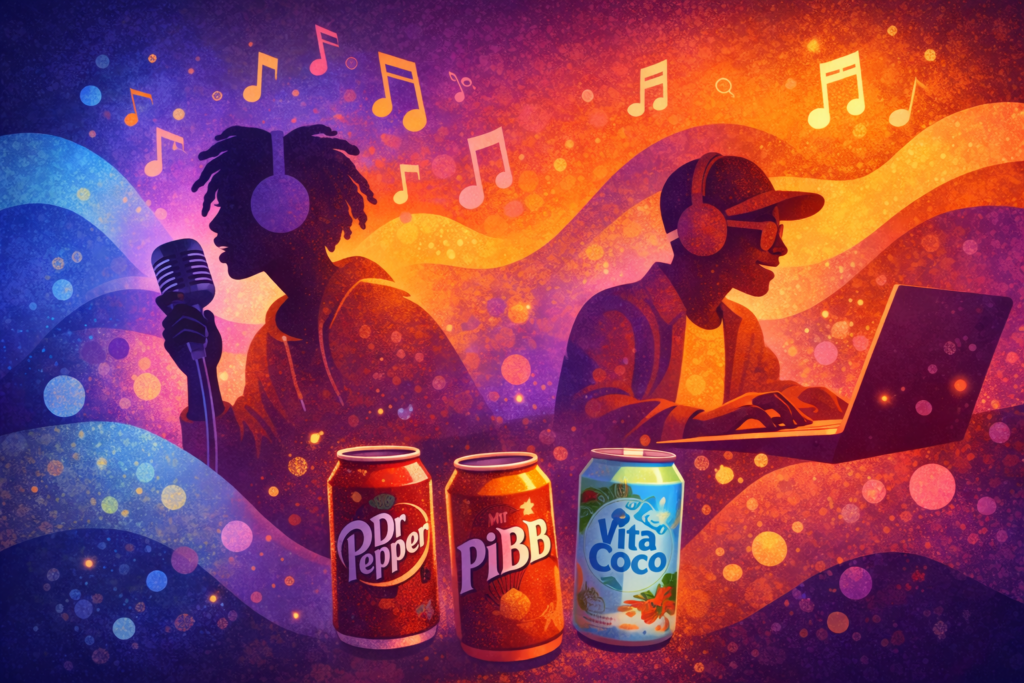
From Bedroom To Broadcast: The Strategic Anatomy of the Jingle Wave
An 11-second TikTok should not end up on national television.
Yet that is exactly what happened when Romeo Bingham posted a jazzy Dr Pepper hook that crossed 125 million views and was later turned into a College Football Playoff National Championship commercial.
Then something more interesting happened.
The format spread.
Romeo created additional jingles, including Vita Coco.
@iam_burrell dropped a rival Mr. Pibb anthem.
Audiences began chanting. Remixing. Requesting more brands.
This was not a one-off viral hit.
It was the emergence of a participatory jingle format inside beverage culture.
Let’s break this down the right way.
Phase One: Romeo Ignites The Format With Dr Pepper
“Dr Pepper, baby, it’s good and nice.”
Simple. Jazzy. Memorable.
The brilliance was not just the melody. It was the structure:
- Brand name first
- Conversational tone
- Short runtime
- Groove-driven rhythm
- Immediate replay value
The clip felt homemade. It was not selling anything. It was not affiliate-coded. It was joyful.
That authenticity matters. According to TikTok for Business, users perceive creator content as significantly more authentic than traditional brand ads (https://www.tiktok.com/business/en/blog/tiktok-marketing-science-authenticity).
Then Dr Pepper did something critical.
They partnered with Romeo, compensated them, credited them on screen, and aired the jingle nationally.
That single decision transformed a viral moment into a trust-building moment.
Edelman’s 2024 Trust Barometer shows that fairness and transparency significantly impact brand trust (https://www.edelman.com/trust/2024/trust-barometer). Dr Pepper did not extract value. They shared it.
That distinction is everything.
Phase Two: The Format Proves Portable
After the Dr Pepper moment, the internet did not just move on.
The jingle format itself became a template.
Romeo wrote for Vita Coco:
“You’ll go loco ’cause it’s so dang delicioso.”
Now we see the mechanics more clearly.
- Tight rhyme scheme
- Phonetic play
- Cultural cues
- Call-and-response ending
This one leaned into tropical flair instead of smooth soda warmth.
Same structure. Different brand posture.
That is the sign of a format, not a fluke.
Phase Three: @iam_burrell’s Mr. Pibb Anthem Introduces Competitive Energy
The Mr. Pibb jingle, created by @iam_burrell, shifts tone dramatically:
“Claims they a doctor…”
This is comparative positioning wrapped in funk.
Instead of affection, we get rivalry.
Instead of cozy vibes, we get swagger.
The structure still holds:
- Immediate brand framing
- Clear antagonist
- Sensory usage scenarios
- Repeated hook
But the emotional posture changes.
That is important.
The format was flexible enough to support:
Dr Pepper: warm loyalty
Vita Coco: playful tropical energy
Mr. Pibb: challenger defiance
When multiple creators independently adapt the same mechanics to different brands, you are witnessing structural virality.
Why The Funk Foundation Matters
All three jingles share a groove-forward backbone.
Not orchestral.
Not cinematic.
Not overproduced.
Funk communicates confidence without aggression. It is rhythmic, physical, participatory.
Research from McGill University shows groove-based rhythms activate motor regions in the brain, increasing engagement and memorability (https://www.mcgill.ca/newsroom/channels/news/science-behind-why-we-move-music-254245).
In plain terms: if it makes you nod your head, it sticks.
Most brand teams focus on visual identity. Very few audit their rhythmic identity.
That gap is now strategic.
TikTok reports that 73 percent of users say sound plays a central role in their experience (https://www.tiktok.com/business/en/blog/sound-on-tiktok).
Sound is no longer background. It is infrastructure.
The Real Strategic Signal
This moment reveals three deeper shifts.
1. Brands Are No Longer Primary Narrators
Creators are.
Romeo wrote Dr Pepper’s most memorable recent ad.
@iam_burrell reframed Mr. Pibb’s competitive positioning.
Brands reacted. They did not initiate.
That inversion is permanent.
2. Identity Density Determines Singability
Dr Pepper works because it is distinct.
Mr. Pibb works because it has rivalry narrative.
Vita Coco works because it has phonetic and cultural cues.
If your brand requires three slides to explain, it will not survive 11 seconds of melody.
Singability is a proxy for clarity.
3. Compensation Is A Reputation Strategy
Audiences noticed that Dr Pepper paid Romeo.
NPR highlighted that people appreciated the brand not capitalizing on free marketing.
In the creator economy, appropriation damages trust faster than silence.
Brands must:
- Move quickly
- Pay fairly
- Credit visibly
- Preserve tone
Anything less feels extractive.
What CMOs Should Do Now
This is not about launching a “jingle contest.”
It is about operational readiness.
Build:
- Real-time social listening systems
- Pre-approved creator contract templates
- Flexible amplification budgets
- Cross-channel integration plans
Dr Pepper did not just respond creatively. They responded operationally.
That is why the moment scaled.
Final Thought
This was not one creator’s lucky break.
It was a cultural stress test.
The internet picked up three beverage brands and tried to sing them.
All three held up.
That is the lesson.
If someone wrote a 15-second funk anthem about your brand tomorrow, would it feel natural?
Would there be a rhyme to grab?
Would there be a rivalry to poke?
Would there be a personality to amplify?
In 2026, brand strength is measured not just by impressions.
It is measured by whether culture can carry your chorus.
And if culture hands you a hit, the smartest thing you can do is step back, pay the artist, and let the groove play.