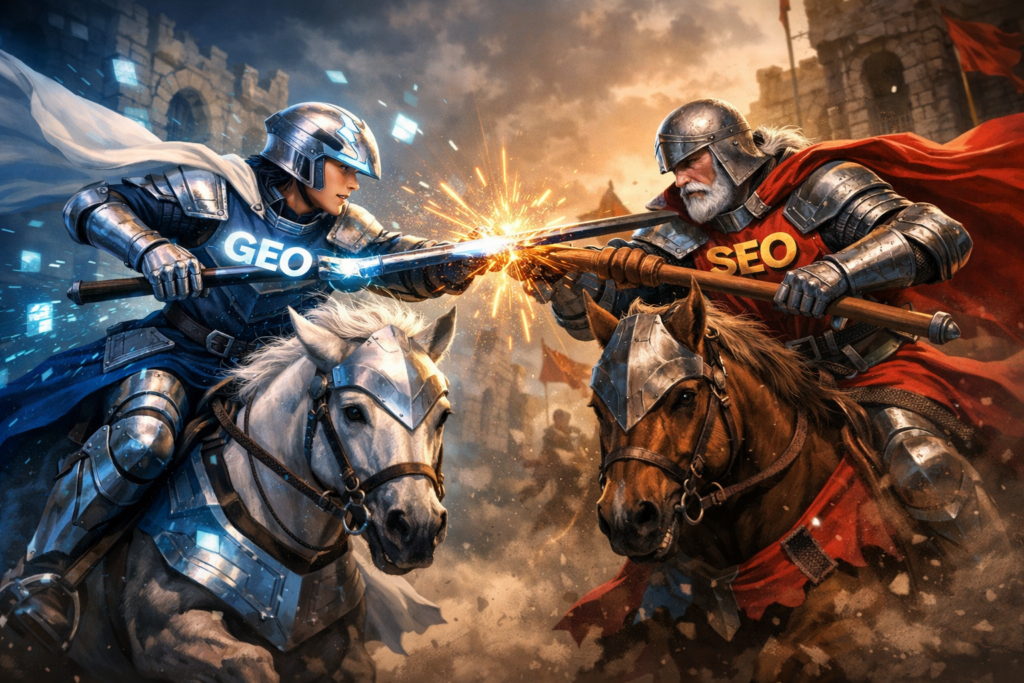
GEO Is the New SEO: Year-End Learnings
For most of the last decade, SEO lived in a relatively stable universe. Algorithms evolved, but the core mechanics stayed familiar. You researched keywords, built content clusters, optimized technical hygiene, earned links, and waited patiently for rankings to compound. Search rewarded discipline and scale. It was slow, but it was predictable.
Then generative search arrived and quietly changed the rules.
By the end of this year, it became clear that we are no longer optimizing only for search engines. We are optimizing for answers. Discovery is no longer limited to ten blue links. It now lives inside summaries, conversational interfaces, AI-generated overviews, shopping copilots, and recommendation layers that sit between users and the open web.
This is where GEO enters the conversation.
GEO, or Generative Engine Optimization, is not a rebrand of SEO. It is a structural shift in how brands earn visibility when machines synthesize information on a user’s behalf. If SEO taught us how to rank pages, GEO is teaching us how to become a cited source inside AI-driven outputs.
This piece is a year-end synthesis of what actually changed, what worked in practice, and how advanced marketers should recalibrate going into the next planning cycle.
Why Search Behavior Changed Faster Than Most Teams Expected
The biggest misconception we saw this year was assuming that generative search was a future problem. In reality, user behavior shifted before most measurement frameworks caught up.
Consumers now expect search to behave like a conversation. They ask longer questions. They seek synthesis instead of sources. They want context, comparison, and confidence, not ten options and a click burden.
Platforms responded accordingly.
Google rolled out AI Overviews across commercial and informational queries. OpenAI normalized search-like behavior inside ChatGPT. Microsoft pushed Copilot deeper into Bing and productivity tools. Perplexity AI gained traction by blending citations with conversational answers.
Each of these experiences shares one defining trait. The user often gets what they need without clicking through.
According to Google’s own disclosures, AI Overviews now appear in over 20 percent of U.S. searches, with higher concentration in complex queries and early-funnel research.
Source: https://blog.google/products/search/ai-overviews-search
This does not mean search traffic disappears. It means traffic concentrates around fewer, more authoritative sources. The long tail compresses. The middle thins out. Winners earn disproportionate visibility. Everyone else fades into the background.
From Ranking Pages to Being Referenced by Systems
Traditional SEO asked a simple question. How do we rank?
GEO asks a different one. How do we get referenced?
Generative systems do not crawl and rank in the same way humans read SERPs. They ingest, summarize, cross-reference, and prioritize based on trust signals that extend beyond keywords.
Through dozens of content audits this year, a pattern emerged.
Pages that performed well in generative results shared five characteristics.
First, they answered questions directly. Not eventually. Not after a scroll. Immediately.
Second, they demonstrated first-hand expertise. Original insights, proprietary data, or clear experiential framing consistently outperformed generic summaries.
Third, they were structured for extraction. Clean headings, scannable sections, explicit definitions, and unambiguous language made it easier for AI systems to pull and reassemble information accurately.
Fourth, they aligned with entity-based understanding. Brands, products, people, and concepts were clearly contextualized, not implied.
Fifth, they showed signs of trust beyond the page itself. Mentions across reputable sites, consistent brand narratives, and authoritative authorship mattered more than isolated optimization.
This is why GEO rewards clarity over cleverness. Machines do not infer nuance the way humans do. They reward precision.
What Actually Broke in Classic SEO This Year
It would be misleading to say SEO stopped working. What broke was overreliance on tactics that assumed search visibility was linear.
Three things in particular lost effectiveness.
Keyword-first content strategies became brittle. Pages written to target narrow variations without adding new perspective were the first to be summarized and bypassed by AI overviews.
Surface-level listicles declined sharply. When generative systems can produce a decent top-ten list on demand, only lists with original framing or data retained value.
And traffic as the primary KPI became unreliable. Many teams saw impressions remain flat or even rise while clicks dropped. Visibility did not disappear. Attribution did.
This created internal tension. Content teams were “winning” while revenue teams saw fewer sessions. The disconnect was measurement, not performance.
The Measurement Shift Most Teams Are Still Avoiding
One of the hardest lessons this year was accepting that last-click organic attribution no longer tells the full story.
GEO-driven visibility influences decisions upstream. A founder reads an AI summary. A buyer asks a chatbot for vendor comparisons. A marketing lead sees your brand name referenced before ever visiting your site.
By the time they convert, organic looks like it had no role.
Advanced teams began adapting in three ways.
They tracked branded search lift alongside generative exposure. When AI systems referenced a brand, branded queries often followed within days.
They correlated content publication dates with downstream assisted conversions, not just direct sessions.
And they used qualitative signals. Sales calls mentioning “I saw you mentioned in…” became a legitimate performance indicator.
This mirrors how PR has always worked. GEO is functionally collapsing the wall between search, content, and brand authority.
How Content Strategy Evolved for Teams That Won
The strongest GEO performers did not abandon SEO fundamentals. They reframed them.
Instead of keyword clusters, they built knowledge hubs. One topic. One authoritative point of view. Multiple supporting assets that reinforced each other.
Instead of chasing every query, they focused on the questions AI engines consistently answer. How does this work. What should I choose. What are the tradeoffs. What mistakes should I avoid.
Instead of publishing more, they published better.
One B2B brand we worked with reduced output by 40 percent and doubled assisted conversions within six months. The shift was not volume. It was depth. Each piece was written to stand alone as a definitive reference.
This aligns with broader guidance from Google’s Search Quality Evaluator framework, which increasingly emphasizes experience, expertise, authority, and trust.
Source: https://developers.google.com/search/docs/essentials/eeat
Technical SEO Did Not Go Away. It Got Table Stakes
A misconception that surfaced late this year was that GEO makes technical SEO irrelevant.
The opposite is true.
If your content cannot be crawled, parsed, and understood cleanly, generative systems will not surface it. Schema markup, structured data, fast load times, and clear information architecture became prerequisites, not advantages.
What changed is that technical SEO alone no longer differentiates. It enables participation. It does not guarantee visibility.
Think of it like infrastructure. Necessary. Invisible when done right. Fatal when ignored.
Brand Is the Silent Ranking Factor No One Can Hack
Perhaps the most uncomfortable realization for performance-driven teams was this. Brand strength influences generative visibility.
AI systems are trained on the public internet. Brands that are consistently mentioned, cited, reviewed, and discussed across trusted domains naturally surface more often in synthesized responses.
You cannot keyword-optimize your way into that position.
This is where GEO and brand strategy converge.
Thought leadership content. Executive visibility. PR placements. Podcast appearances. High-quality backlinks that actually reflect reputation, not tactics.
All of these feed the same ecosystem that generative engines draw from.
For years, brand marketing was treated as a nice-to-have. GEO turned it into an operational necessity.
This is also where many teams rediscovered the value of integrated strategies, not channel silos. Content without distribution stalled. Distribution without substance faded. Only cohesive narratives scaled.
What Advanced Marketers Should Do Differently Next Year
Going into the next planning cycle, GEO should influence how you brief, build, and evaluate content.
Start briefs with the answer, not the keyword. Ask what question this content must resolve completely.
Write for extraction. Assume your content will be summarized. Make sure the summary would represent you accurately.
Invest in original inputs. Data, frameworks, point-of-view analysis, and firsthand experience are harder for AI to replicate and easier for it to credit.
Expand success metrics. Track assisted influence, brand lift, and sales feedback alongside traffic.
And most importantly, stop treating SEO as a channel. Treat it as a visibility layer that now extends far beyond your site.
At Hawke Media, we have been advising clients to approach GEO the same way we approach modern media buying. You do not optimize for a placement. You optimize for presence across the system. The same philosophy that underpins our SEO strategy work applies here, just with a broader lens. More on that approach can be found here: https://hawkemedia.com/services/seo
The Bigger Takeaway
GEO did not replace SEO. It exposed what SEO was always evolving toward.
Search is no longer about finding pages. It is about finding answers you trust.
Brands that win in this environment do not chase algorithms. They earn inclusion by being genuinely useful, clearly authoritative, and consistently visible wherever machines learn from the internet.
The year-end learning is simple, even if execution is not.
If your content is good enough to teach a human, it is good enough to train a machine.
The brands that internalize that mindset now will not be scrambling when generative discovery becomes the default. They will already be there, calmly cited, confidently present, and impossible to ignore.