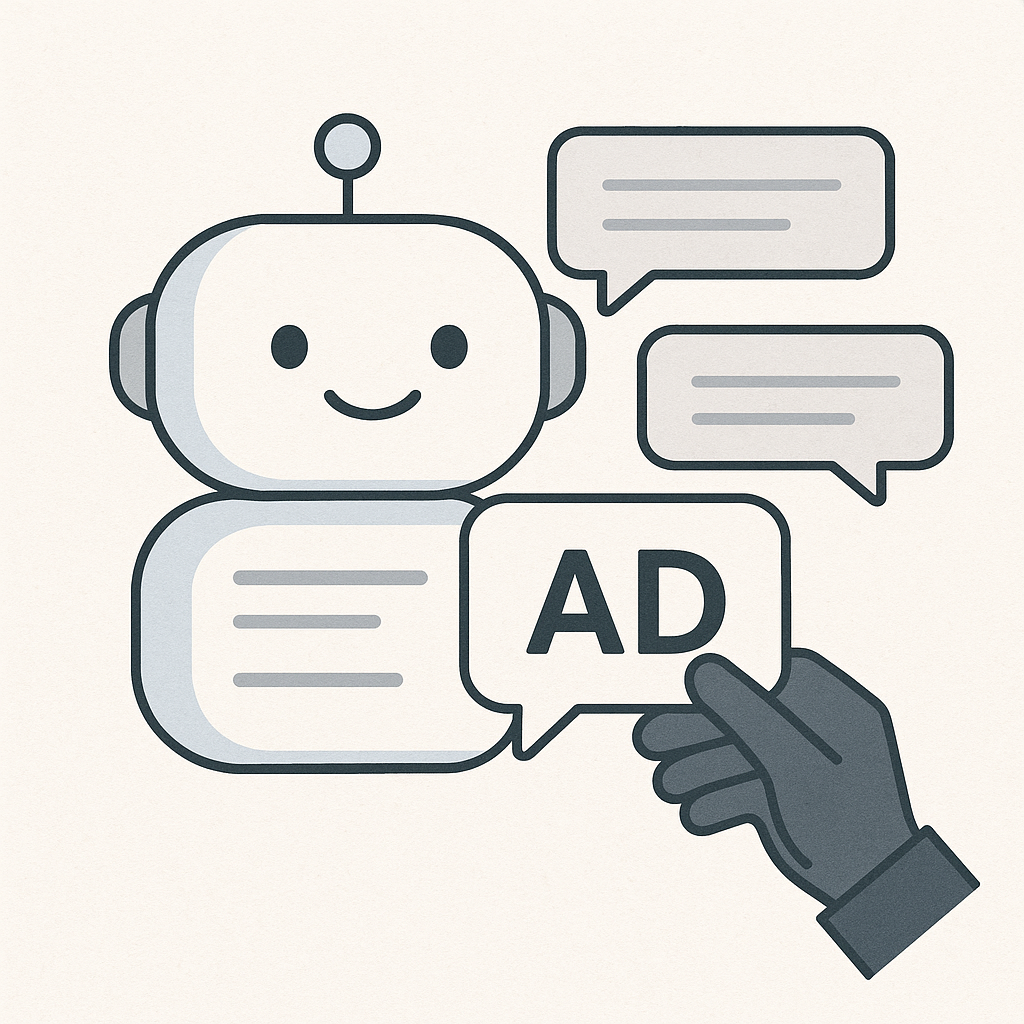
Google Says “No ads in Gemini,” but Ad Roadmap Still Moving Toward Chat
Adweek’s report is simple and spicy: Google reps allegedly told at least two advertising clients that ads are targeted for Gemini in 2026, separate from ads in AI Mode, and without prototypes or tech details shared yet.
Then the immediate counterpunch landed. Google’s VP of Global Ads, Dan Taylor, publicly called the report inaccurate and said there are no ads in the Gemini app and “no current plans” to change that.
If you are an advertiser, you do not need to pick a side in a he said, she said to extract value. What matters is the pattern: Google is already commercializing generative answers inside Search (AI Overviews) and actively testing ads inside Search’s conversational AI Mode. Whether Gemini becomes an ad surface in 2026 or later, the direction of travel is clear: paid media is being pulled upward into the “answer layer,” not just the list of links.
Google has said Search and Shopping ads are expanding in AI Overviews (including expansion to desktop in the U.S., plus expansion beyond the U.S. for English over time), and it is experimenting with ads in AI Mode responses.
So, even if Gemini stays “ad-free for now,” your 2026 search plan should assume generative surfaces will keep growing. The only surprise would be pretending they will not.
Why this rumor is believable, even with a denial
1) The economics of AI do not run on vibes
Alphabet’s advertising engine is still the heartbeat of the business. In Q3 2025, Google Search & other advertising revenue alone was reported at $56.6B. That scale funds the capex and compute reality of modern AI.
When you zoom out, “ads in chat” stops sounding like a gimmick and starts sounding like a business model eventually seeking a home.
2) Google is already placing ads in generative answers, just not necessarily in Gemini
Google’s own materials are explicit that ads can appear in AI-driven Search experiences:
- AI Overviews are a Search feature, and Google provides advertiser guidance on “ads and AI Overviews.”
- Google also states it is testing ads in AI Mode in the U.S., where relevant ads may appear “below and integrated into AI Mode responses.”
- Google has also described expanding ads in AI Overviews and experimenting with ads in AI Mode in its thought leadership content.
This matters because it reframes the headline. The real shift is not “Gemini gets ads.” The shift is “generative UX becomes monetizable inventory.”
3) Platform pressure is coming from both directions (users and regulators)
Users are jumpy about anything that smells like stealth ads inside assistants, and that sensitivity has already shown up across the category.
At the same time, regulators are scrutinizing how AI search features use publisher content, which forces Google to add more sourcing and transparency in experiences like AI Mode. Those dynamics shape how ads can appear: clearer labeling, clearer sourcing, and a bigger spotlight on “what is organic vs paid” inside a blended answer.
The most likely ways “Gemini ads” would actually show up
No one outside Google has a spec sheet, and Adweek’s sources explicitly said no prototypes were shown. So the useful move is to reason from adjacent systems that do exist: AI Overviews ads and AI Mode ad tests.
Here are the formats I would expect to be most plausible, because they map to what Google already sells and measures:
- Sponsored modules beneath an answer
This is closest to the “below the response” pattern already described for AI Mode testing. - Inline sponsored cards embedded in the response flow
Google has already suggested that ads may be “integrated into AI Mode responses” when relevant. If Gemini ever becomes an ad surface, this is the high-yield inventory, and also the one that requires the strictest labeling to avoid backlash. - Commerce-first placements that behave like Shopping
Google has emphasized Search and Shopping ads within AI Overviews and brand discovery. If Gemini goes down the monetization path, commerce intent will be the least controversial starting point, because users already expect product recommendations and sponsored placements around shopping. - “Agentic” moments with monetized suggestions
As assistants become more agent-like (planning, booking, comparing), the ad opportunity becomes “pay to be shortlisted.” But this also introduces new risk. Google is actively discussing security issues for agentic browsing experiences, including indirect prompt injection. If your brand is going to be recommended by an agent, you will care about both fraud and brand safety in a more literal way than “my banner appeared next to bad content.”
What this means for advertisers: the playbook shifts from keywords to credibility plus eligibility
I’ll put this in a scene you have probably lived through.
A paid search lead hears about “ads in AI answers” and immediately asks, “Cool, what’s the CPC?”
A growth lead asks, “Will this cannibalize my clicks?”
A brand lead asks, “Are we going to look like we bought our way into the answer?”
And the CMO, doing the mental math, asks, “What do we need to do now so we are not late later?”
The answer is not one tactic. It is three workstreams running in parallel.
Workstream 1: Win eligibility in Google’s AI ad surfaces
Google has been clear that AI-powered Search ad placements are tied to existing systems and campaign types. For AI Overviews, Google has discussed Search and Shopping ads and expansions across devices and markets.
What to do now:
- Make Performance Max actually usable, not just “turned on.” Feed hygiene, asset group logic, and clean conversion signals matter more when the auction is trying to match to complex, conversational intent.
- Treat your Merchant Center feed like a product database, not a spreadsheet. Titles, GTINs, high-res images, shipping, return policy, and structured attributes become the difference between “eligible to show” and “invisible.”
- Get serious about first-party measurement. AI surfaces tend to compress journeys. If your measurement relies on last-click and fuzzy UTM discipline, you will not be able to tell if AI placements are incremental or just relocating credit.
Workstream 2: Build the “AI answer footprint” that supports both paid and organic
This is the part too many teams split into silos: SEO does “content,” paid does “budget,” and nobody owns “how the brand shows up inside answers.”
But generative answers are not just rankings. They are interpretations of your brand. If you do not provide clean, consistent signals, models fill gaps with whatever they can infer.
This is where GEO (Generative Engine Optimization) stops being a trendy acronym and becomes a defensive moat. Hawke’s GEO framing is straightforward: structure content, schema, and brand presence so AI systems can recognize, trust, and recommend you across experiences like ChatGPT, Gemini, and AI-powered search results.
What to do now:
- Write for questions, but also for entities. Make sure your site is unambiguous about who you are, what you sell, what you do not sell, where you operate, and what makes you credible.
- Use structured data intentionally. Product, FAQ, Organization, Author, Review markup. Not as decoration, as a machine-readable truth layer.
- Audit how AI tools describe you today. Then fix inconsistencies like outdated pricing, wrong positioning, or confusing category language.
If you want a practical starting point, Hawke’s GEO service page lays out a concrete engagement flow (baseline assessment, opportunity mapping, roadmap, implementation, monitoring).
Workstream 3: Prepare creative that can survive inside an answer
In a classic SERP, your ad competes with ten blue links and a couple of rivals. In an answer-driven UI, your ad competes with the assistant’s confidence.
That changes creative requirements:
- You need claims that are verifiable.
- You need proof points that fit into short snippets.
- You need assets that work as modules, because AI-driven placements often assemble context dynamically.
A helpful mindset is to think like a newsroom editor: if your ad is going to sit next to an AI-generated explanation, does your creative add value, or does it read like an interruption?
Hawke’s own content on AI and experimentation is a good reminder here: let AI speed up testing, but keep human guardrails, especially around accuracy.
The biggest risk: “answer pollution” and brand trust blowback
The fastest way for this whole category to get ugly is if users feel the assistant is paid to “decide” rather than paid to “show options.”
That is why labeling and transparency are not just compliance details, they are performance drivers. Google is already moving toward more visible sourcing in AI Mode, adding more links and context for sources. The more the UI trains users to look for sources, the more your brand will need to earn its place with credibility signals, not just budget.
There is also a second-order risk: if AI answers reduce publisher traffic, regulators and publishers will push back, and ad formats will evolve under scrutiny. The EU probe into Google’s AI Overviews and use of online content is a signal that the environment around these products is not settled.
A pragmatic 2026 readiness checklist
If you want to walk into planning season with a calm face, here is what I would lock by end of Q1 2026:
- Feed and schema cleanup completed (products, organization, FAQs, reviews).
- Performance Max and Search structure tightened (clear goals, clean conversion signals, creative asset coverage).
- Brand facts standardized everywhere (site, Wikipedia alternatives, major directories, press boilerplates, investor pages, product pages).
- “Answer-ready” creative library built (short proof points, comparisons, use cases, pricing anchors, guarantees, shipping, returns).
- Incrementality testing plan that can handle new placements without panic (geo tests, holdouts, media mix, brand lift where possible).
- Cross-functional ownership established (paid, SEO, product marketing, legal, comms) because answer-layer ads touch everything.
If you want a Hawke-specific companion to this, the GEO optimization article is a strong baseline for how to structure content for LLM-driven discovery, and the Mon Ami case study is a useful reference point for how modern Google media systems (broad match + predictive signals + Performance Max) are already being treated as discovery engines, not just demand capture.
The bottom line
Adweek’s reporting may or may not become an on-the-record product launch in 2026. Google’s denial might be literal today and irrelevant tomorrow.
But the bigger truth is not up for debate: Google is actively monetizing generative search experiences (AI Overviews) and testing ad experiences inside conversational search (AI Mode).
If you are waiting for a “Gemini ads product announcement” to start adapting, you are already late. The real move is to build eligibility, credibility, and creative that belongs inside answers, so when the inventory shifts, your performance does not fall off a cliff.
Sources (URLs written out for reference)
Adweek report: https://www.adweek.com/media/google-gemini-ads-2026/
Google denial coverage (Search Engine Land): https://searchengineland.com/google-corrects-report-claiming-ads-are-coming-to-gemini-in-2026-465856
Google AI Mode announcement: https://blog.google/products/search/google-search-ai-mode-update/
Google Ads Highlights of 2025 (AI Mode ad testing): https://support.google.com/google-ads/answer/16756291
Google on ads in AI Overviews and expansion: https://blog.google/products/ads-commerce/google-search-ai-brand-discovery/
Google “future of AI-powered Search marketing”: https://business.google.com/us/think/search-and-video/ai-powered-search-marketing/
Alphabet Q3 2025 earnings call page: https://abc.xyz/investor/events/event-details/2025/2025-Q3-Earnings-Call-2025-4OI4Bac_Q9/default.aspx
Reuters on EU antitrust probe: https://www.reuters.com/sustainability/boards-policy-regulation/eu-launches-antitrust-probe-into-googles-use-online-content-ai-purposes-2025-12-09/
Hawke internal references
Hawke GEO service page: https://hawkemedia.com/geo-aeo/
Hawke GEO content guide: https://hawkemedia.com/insights/geo-generative-ai-search-optimization/
Hawke AI A/B testing: https://hawkemedia.com/insights/ai-ab-testing/
Hawke AI hallucinations safeguards: https://hawkemedia.com/insights/ai-cant-be-trusted/
Hawke case study (Mon Ami): https://hawkemedia.com/case-studies/mon-ami/