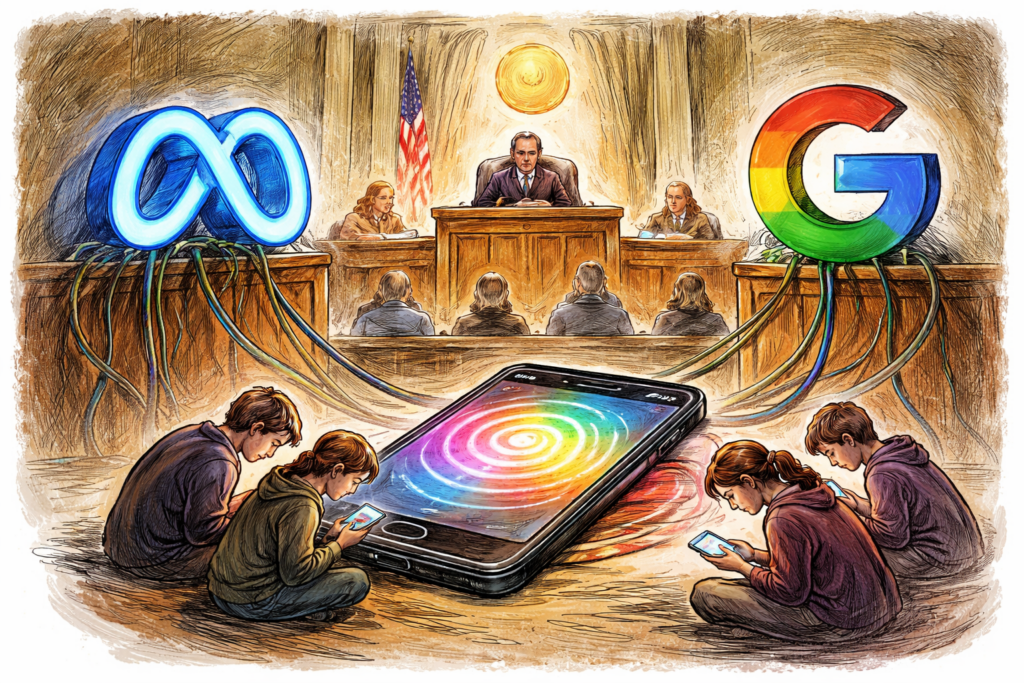
Meta and YouTube Found Negligent: What This Landmark Case Means for Marketers, Platforms, and the Future of Digital Growth
On March 25, 2026, a jury in Los Angeles delivered a verdict that could reshape how digital platforms are viewed, regulated, and ultimately leveraged by marketers.
Meta and Google were found negligent in a case centered on social media addiction and harm to young users, specifically tied to platforms like Instagram and YouTube.
This is not just another tech lawsuit. It is one of the first major jury decisions to assign legal responsibility to platform design itself.
For marketers, founders, and growth leaders, the implications are real. But before jumping to conclusions, it’s critical to separate what actually happened from what it might mean.
What the Jury Actually Found
The verdict was focused and specific.
The jury found that both Meta and Google were negligent in how their platforms were designed and operated, particularly in ways that could contribute to compulsive use among minors. The case also centered on whether the companies failed to adequately warn users and families about potential harms.
This is the key shift.
Historically, platforms have defended themselves as neutral intermediaries. This ruling challenges that framing by suggesting that design choices themselves can create liability.
It is important to note what this case does and does not do:
- It does not create a nationwide law
- It does not immediately force product changes
- It does not apply universally to all users or all cases
What it does do is establish a legal precedent that plaintiffs can point to in future cases.
And in the legal world, precedent is momentum.
The Damages and Why They Matter
Reporting on damages has varied slightly across early coverage, but what is clear is this:
The jury awarded millions in damages and assigned a larger share of liability to Meta than to Google.
That split matters.
It signals that not all platforms are viewed equally in how they design and operate engagement systems. For brands heavily invested in Instagram or YouTube, this could become relevant as future cases dig deeper into platform-specific mechanics.
This is less about the dollar amount and more about the signal it sends.
A jury was willing to connect product design to real-world harm and assign financial consequences.
That is a meaningful escalation.
Why This Case Is Different From Everything Before It
The tech industry has faced lawsuits for years. Privacy violations. Data misuse. Antitrust claims.
This case is different because it targets the core of how platforms function.
Not data collection. Not advertising practices. The actual experience of using the product.
That includes:
- Algorithmic content delivery
- Engagement loops
- Content recommendation systems
For the first time at this level, those elements are being treated as potential sources of harm, not just features.
For marketers, that distinction is critical.
Because those same systems are what drive reach, performance, and scale.
What This Does Not Mean (Yet)
There is a temptation to overcorrect when news like this breaks.
Let’s be clear about what has not happened.
There is no immediate ban on algorithmic feeds. Infinite scroll has not disappeared overnight. Paid social is not suddenly ineffective.
There are also likely appeals ahead, which could extend this process significantly.
What we are seeing is not an instant shift in platform mechanics. It is the beginning of pressure that could lead to change over time.
That time horizon matters for planning.
The Real Risk for Marketers Is Indirect
The biggest impact will not come from this single ruling. It will come from what follows.
Legal pressure tends to create three downstream effects:
1. Product Adjustments
Platforms may begin introducing more controls, transparency, or friction into the user experience to reduce risk.
Not because they are forced to immediately, but because they want to stay ahead of future litigation.
2. Regulatory Acceleration
Cases like this often influence policymakers. They provide a narrative and a reference point for future regulation.
3. Public Perception Shifts
Consumers become more aware of how platforms operate. That awareness can change behavior, even before any formal changes are made.
For marketers, this combination is where the real impact lives.
A Subtle Shift Already Underway
A founder we worked with recently flagged something interesting.
Their paid social performance had not collapsed, but engagement quality had changed. Comments were more skeptical. Audiences asked more questions. Conversion took longer.
Nothing in the algorithm had officially changed.
But perception had.
That is the kind of shift this ruling accelerates.
Not an overnight drop in performance, but a gradual change in how users interact with content.
The Platform Relationship Is Evolving
For years, brands have treated platforms like growth engines. Feed in creative and budget, optimize against performance metrics, scale what works.
That model still works, but it is becoming more fragile.
This ruling reinforces that platforms are not static environments. They are evolving systems influenced by legal, cultural, and regulatory forces.
That means strategies need to be more adaptive.
Not just optimized for today’s algorithm, but resilient to tomorrow’s changes.
What Smart Brands Should Do Right Now
This is not a moment to panic. It is a moment to recalibrate.
Here is how leading brands should be thinking about the next phase.
Diversify Channel Dependence
If a significant portion of growth relies on one or two platforms, that is a vulnerability.
Expanding into owned and alternative channels reduces exposure to platform-specific changes.
Strengthen Owned Media
Email, SMS, and direct audience relationships are not subject to the same external pressures.
They provide consistency when platforms shift.
Elevate Creative Quality
As scrutiny increases, content that feels manipulative or overly engineered may face resistance from both users and platforms.
Content that provides value, clarity, or entertainment without friction will perform more consistently.
Invest in Brand
When performance marketing becomes less predictable, brand equity becomes a stabilizer.
It lowers acquisition costs over time and builds resilience into the system.
The Long-Term Implication: Accountability Enters the Growth Equation
The most important takeaway is not tactical. It is philosophical.
For the first time, there is a clear signal that growth mechanisms themselves can be scrutinized.
That changes how success is defined.
It is no longer just about reach, engagement, and conversion. It is also about how those outcomes are achieved.
That may sound abstract, but it will become very practical.
Brands that align growth with user value will have an easier time adapting to whatever comes next.
Brands that rely on short-term tactics may find themselves constantly reacting.
Final Thought
This verdict does not rewrite the rules overnight. But it does redraw the boundaries.
Social platforms are still powerful. They are still essential. But they are no longer operating without consequence.
For marketers, the opportunity is not to retreat. It is to evolve ahead of the curve.
Because the next era of growth will not just reward performance.
It will reward responsibility.