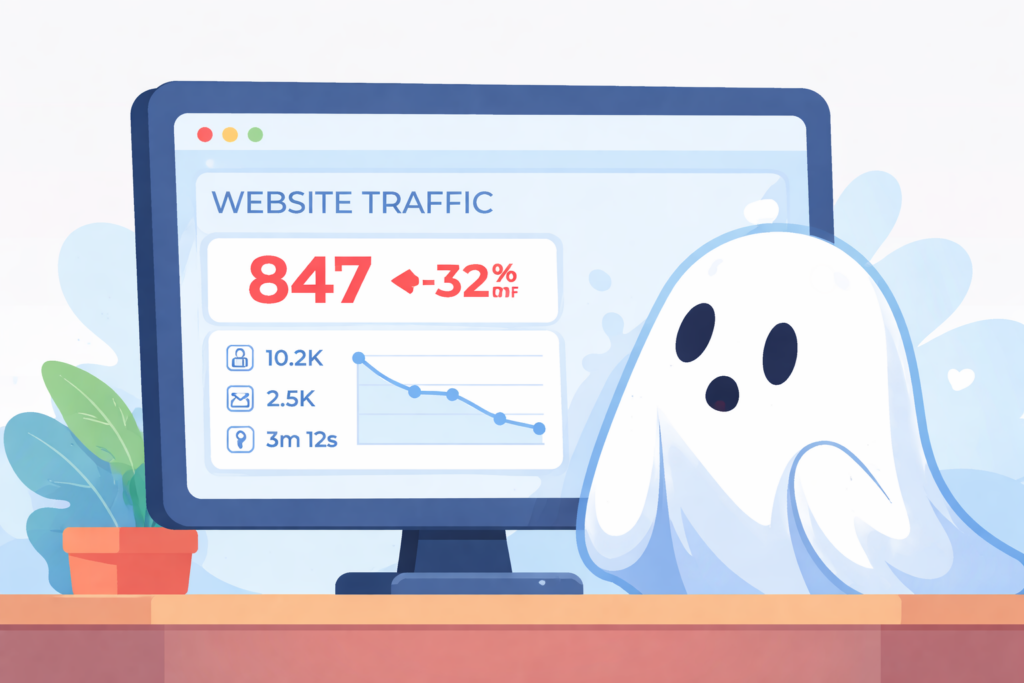
In 2026 Growth Is No Longer About Traffic. It’s About Visibility.
For most of the past two decades, growth marketing followed a familiar rhythm. You drove traffic. You optimized conversion rates. You scaled what worked. The playbook rewarded brands that could attract clicks at volume and monetize attention efficiently.
That era is closing.
In 2026, the growth curve is bending away from raw traffic and toward something quieter, harder to measure, and far more consequential. Visibility. Not visibility as in impressions or reach, but visibility inside decision-making moments where consumers never open a browser tab, never scan a list of links, and never click through to your site.
Growth is now shaped by whether your brand shows up when an AI answers a question on your customer’s behalf.
This shift is not theoretical. It is already happening at scale across tools like Google AI Overviews, OpenAI’s ChatGPT, Perplexity AI, and enterprise copilots embedded into productivity software. The customer journey is compressing. Discovery, evaluation, and recommendation are collapsing into a single response. If your brand is not visible inside that response, it might as well not exist.
This article is a refresher for experienced marketers who sense this shift but need a clearer framework to act on it. We will unpack what visibility actually means in 2026, why traffic is losing its primacy, and how brands can engineer presence inside AI-driven discovery systems without chasing vanity metrics or buzzwords.
Traffic Was a Proxy. Visibility Is the Outcome.
Traffic was never the goal. It was a proxy. A way to infer that awareness existed, demand was forming, and customers were finding you during moments of intent.
For years, traffic worked because search engines acted like directories. They surfaced options, and users chose where to go next. Marketers optimized for rankings, click-through rates, and landing page performance because clicks were the gateway to influence.
AI systems break that model.
When a consumer asks, “What is the best CRM for a mid-sized ecommerce brand?” the AI does not return ten blue links. It returns an answer. Often with a shortlist. Sometimes with a single recommendation. Increasingly with no visible source attribution at all.
In those moments, traffic is irrelevant. The decision happens before a click exists.
Visibility is whether your brand is included, referenced, or implied in the response that shapes the decision.
That distinction matters because it changes what success looks like. A brand can see flat or declining organic sessions while simultaneously increasing revenue because it is winning upstream in AI-mediated consideration. Conversely, a brand can maintain strong traffic while slowly disappearing from relevance if AI systems stop citing or recalling it.
The New Discovery Stack Is Invisible by Design
One of the hardest adjustments for marketers is psychological. We are trained to optimize what we can see. Dashboards, rankings, impressions, funnels. The new discovery stack operates largely out of view.
AI models learn from vast corpuses of content. They weigh authority signals, consistency, entity relationships, historical performance, and semantic clarity. They do not reward keyword density or clever headline hacks. They reward coherence, credibility, and usefulness across time.
Think of visibility like reputation rather than reach.
Anecdotally, we have seen brands with modest domain authority outrank category leaders inside AI answers simply because their content is clearer, more specific, and more consistently aligned with real-world use cases. The AI does not care who shouts the loudest. It cares who explains the problem best.
This is why traditional SEO tactics alone are insufficient. You cannot brute-force your way into AI answers with backlinks and volume. You have to earn conceptual ownership.
Visibility Is Built on Entity Strength, Not Pages
Search engines used to index pages. AI systems reason about entities.
An entity is a real-world thing. A brand, a product, a founder, a category, a capability. When AI answers a question, it pulls from its internal understanding of how entities relate to one another.
This is why brand clarity matters more than ever.
If your positioning is fuzzy, if your offerings sprawl without clear definitions, if your messaging changes depending on the channel, AI systems struggle to place you accurately. When that happens, you get omitted, miscategorized, or replaced by a competitor with a cleaner narrative.
Strong visibility comes from being unambiguous.
At Hawke Media, we see this most clearly when brands simplify. One SaaS company we worked with reduced its public-facing product descriptions from twelve loosely differentiated features to three tightly defined use cases. Within months, AI-generated answers began referencing the brand correctly for those specific problems. No increase in blog output. No surge in backlinks. Just clarity.
Content Is Still King. But the Court Has Changed.
This is not an argument against content. It is an argument against content for content’s sake.
AI systems privilege depth, structure, and intent alignment. They learn from content that answers real questions fully and consistently across formats. Blog posts matter. Whitepapers matter. FAQs matter. Product pages matter. Thought leadership matters.
What no longer matters is volume without purpose.
A 2,000-word article that says nothing new is worse than useless. It trains AI models to ignore you.
Effective visibility content in 2026 does a few things exceptionally well:
It defines the problem in plain language.
It explains the solution with specificity.
It situates the brand within a broader ecosystem.
It uses consistent terminology across channels.
It reflects lived expertise, not recycled opinions.
This aligns directly with how Hawke approaches content strategy today. Our focus is not publishing frequency. It is publishing authority. That philosophy is embedded across our insights, case studies, and guides, all designed to be cited, remembered, and reused by both humans and machines.
Measurement Is Shifting from Sessions to Signals
If traffic is no longer the leading indicator, what replaces it?
The uncomfortable answer is that there is no single metric yet. Visibility requires triangulation.
Advanced teams are combining multiple signals:
Brand mentions inside AI responses.
Inclusion in AI-generated shortlists.
Direct traffic growth that cannot be attributed to campaigns.
Sales conversations referencing AI tools as discovery sources.
Search console impressions without clicks.
Increased branded query specificity.
None of these are perfect alone. Together, they tell a story.
One ecommerce brand noticed that customer demos increasingly began with phrases like, “ChatGPT recommended you” or “Perplexity mentioned you alongside X.” Their organic traffic was flat. Their pipeline was not. Visibility was doing the work traffic used to do.
This requires a mindset shift. You are optimizing for influence, not visits.
Visibility Requires Cross-Functional Alignment
This is where many organizations stumble.
Visibility is not owned by SEO. It is not owned by content. It is not owned by PR. It is the output of alignment between all three.
PR builds third-party validation and authoritative mentions.
Content defines expertise and narrative consistency.
SEO ensures technical clarity and discoverability.
Product and sales reinforce real-world credibility.
When these functions operate in silos, AI systems receive mixed signals. When they align, the brand becomes legible.
At Hawke, we see the strongest results when brands stop asking, “How do we rank?” and start asking, “How do we explain ourselves so clearly that a machine can summarize us correctly?”
That question changes everything.
Why This Favors Thoughtful Brands, Not Just Big Ones
There is a quiet optimism in this shift.
AI-driven discovery does not automatically favor the largest budget or the loudest advertiser. It favors the most helpful explanation.
Smaller brands with deep expertise can outmaneuver incumbents who rely on brand gravity alone. Niche players can dominate specific queries by owning clarity where larger competitors generalize.
We have seen challenger brands become default answers simply because they articulate their value better.
Visibility rewards substance.
The Playbook for 2026
If you are recalibrating your growth strategy, start here:
Audit your public narrative. Can someone accurately describe what you do in one sentence using your own words?
Map your core entities. Brand, product, category, use case, audience. Are they consistently represented?
Create content that answers real questions fully, not broadly.
Align PR, content, and SEO around the same story.
Listen to sales. How are prospects finding you?
Accept that some influence will be invisible, and that is okay.
This is not about abandoning traffic. It is about recognizing that traffic is now a downstream artifact, not the engine itself.
Growth Belongs to the Visible
In 2026, growth is not a volume game. It is a relevance game.
Brands that win will not be the ones with the most sessions, the most keywords, or the most content. They will be the ones that show up when it matters, in the moment of decision, inside systems that speak for the customer before the customer ever speaks to you.
Visibility is the new compounding asset.
Traffic was rented attention. Visibility is earned memory.
The marketers who understand that distinction now will spend the next decade shaping answers instead of chasing clicks.