What Should Brands Do When AI Overviews Cut Traffic?
There was a time when a dip in organic traffic meant something was broken. Rankings slipped. A competitor moved ahead. A page got stale. The fix was usually straightforward, even if the work was not.
That is not the moment we are in now.
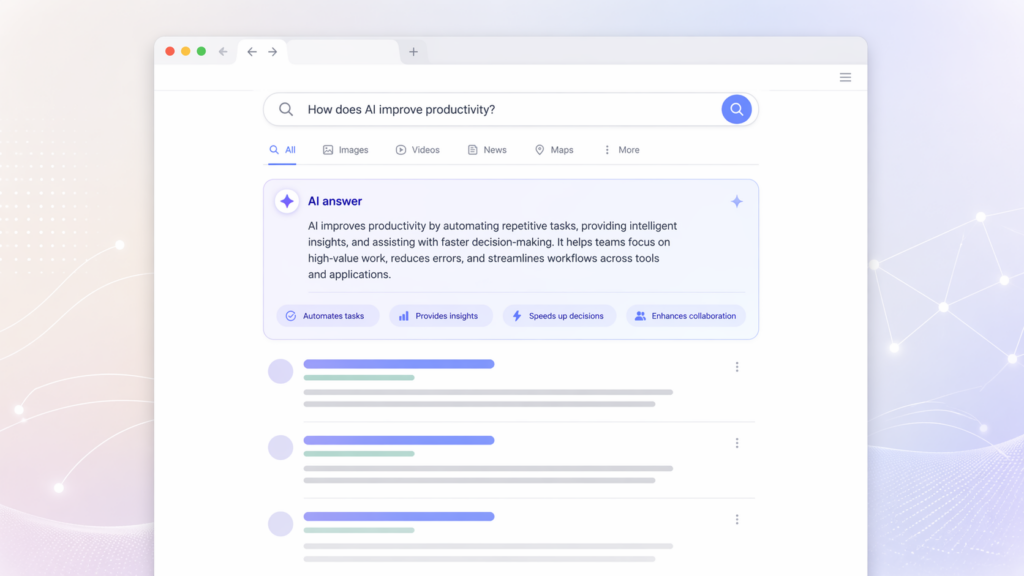
Today, a brand can hold rankings, maintain decent visibility, and still watch traffic soften because Google is answering more of the question before the user ever reaches the site. AI Overviews have changed the shape of search behavior. The result is not just fewer clicks. It is a different model of discovery, one where your content may still influence the decision even when it does not get the visit.
That distinction matters. It changes how brands should measure success, how they should create content, and how they should think about SEO in an era where the search engine increasingly wants to be the destination. Google’s own guidance makes clear that AI features are now a core part of Search, and that the same fundamentals still apply: your content needs to be crawlable, indexable, useful, well-structured, and eligible to appear in snippets and other search features. At the same time, Google says people are asking more complex and longer questions in these AI-powered experiences, which means search is not disappearing. It is evolving into a more mediated form of discovery. Google Search Central’s documentation on AI features lays that out plainly.
The click is no longer the whole story. But it is still part of the story. And if brands respond to AI Overview traffic loss with panic, volume-chasing, or generic SEO content, they are going to make a hard problem worse.
The smarter move is to rebuild your organic strategy around visibility, trust, memory, and conversion.
Get Your Free Consultation
See Hawke’s Success Stories
First, Stop Using Traffic As The Only Health Metric
This is where a lot of teams get trapped.
A blog post that used to bring in ten thousand visits a month might now bring in six thousand. On paper, that looks like decline. But if the people who still arrive are more qualified, if branded search is rising, if demo requests are holding, or if the page is helping your brand get cited in AI-generated answers, then the asset may still be doing valuable work.
Recent research from Pew Research Center shows just how real the click loss is. In its analysis of Google searches from March 2025, users clicked a traditional search result in 8% of visits when an AI summary appeared, compared with 15% of visits when no summary appeared. Users clicked links within the AI summary itself only 1% of the time. The presence of an AI summary also made users more likely to end the session without clicking anywhere.
That means the old scoreboard is too narrow. Brands need to start tracking a fuller organic impact model that includes branded search volume, assisted conversions, demo requests, consultation form fills, newsletter signups, return visits, direct traffic, and downstream revenue by landing page. Google also notes in its AI features reporting guidance that traffic from AI features is currently folded into normal Search Console reporting, not broken out into a separate line item, which makes it even more important to look beyond sessions alone.
This is one of the biggest mindset shifts brands need to make. The question is no longer just, “How many people clicked?” The better question is, “Did this page help us get discovered, trusted, and chosen?”
That is the same logic we recently outlined in Hawke Media’s perspective on traffic vs. visibility, where the headline argument is simple: in 2026, growth is increasingly about visibility, not just traffic.
Create Content That Earns The Click Instead Of Assuming It
A lot of content is getting quietly disintermediated because it never offered much beyond the answer itself.
If your page is a thin “what is X” article assembled from ideas already repeated across fifty other sites, AI Overviews can summarize it cleanly and users can move on. No click needed. No relationship created. No brand remembered.
Google’s guidance on succeeding in AI-powered search is not especially mysterious. It keeps coming back to the same principles: create satisfying content for people, offer unique value, make your page accessible to crawling and indexing, use structured data correctly, and present key information in ways machines can parse and humans can trust. Google also explicitly says in its guidance on how to succeed in AI search experiences that unique, non-commodity content is what tends to stand out.
That means brands should double down on content formats that do more than define the topic. Think comparison pages, decision guides, pricing explainers, implementation walkthroughs, original research, POV-driven thought leadership, customer stories, calculators, templates, and category pages designed around actual buying questions.
Picture two articles on the same topic. One says, “What is lifecycle marketing?” and gives a neat 900-word overview that sounds like every other overview. The other says, “How to Build a Lifecycle Marketing Program for a DTC Brand Under $2M in Revenue,” includes a sample flow map, common mistakes, channel sequencing, benchmarks, and the operational handoff between creative and CRM. The first article is easy for an AI system to compress. The second is much harder to replace because it contains process, judgment, and practical specificity.
That is the goal now. Publish content that still matters after the summary.
Focus On Queries Where Users Still Need To Leave The SERP
Not every keyword deserves equal energy anymore.
AI Overviews are best at answering simple informational questions. They are less effective when the user needs to compare nuanced options, evaluate a provider, understand implementation, review pricing, assess fit, or inspect proof. Those are the moments where a click still has a job to do.
Brands should tilt more of their content strategy toward:
- “Best [solution] for [specific use case]” pages
- “[Option A] vs [Option B]” comparisons
- Service plus industry pages
- Pain-point pages
- Implementation guides
- Pricing and engagement model pages
- Case studies with real specifics
- Checklists, templates, and calculators
- Commercial category pages built for real selection behavior
This does not mean top-of-funnel content is dead. It means top-of-funnel content has to work harder. It needs stronger structure, sharper framing, and more obvious next steps. Informational traffic is now less abundant and more expensive to earn. So every visit has to carry more value.
Turn Informational Content Into A Conversion Surface
Too many brands are still treating blog content like a museum exhibit. Nicely arranged. Interesting enough. Not built to do anything.
That model is now a liability.
If AI Overviews are reducing the number of site visits you receive, then the value of each remaining visit goes up. A blog post should not end with a shrug and a floating social share button. It should move the reader somewhere useful.
Add in-line calls to action. Add contextual offers. Add links to deeper service pages, related guides, diagnostic tools, and customer proof. Add smart email capture where it makes sense. Build the internal path with intent instead of hoping the visitor will wander into a conversion.
This is especially important for service businesses, where a single qualified lead is worth far more than a hundred passive pageviews. Hawke’s own SEO services page reinforces that point in a practical way: content is not just there to attract traffic. It is there to build trust, clarify value, and help move someone toward action.
Build Brand Demand Outside Search
Here is the part many brands do not want to hear because it is less tidy than on-page optimization.
When AI Overviews cut traffic, the brands with the strongest memory structures are in a much better position. If a buyer already knows your name, has heard your founder speak, has seen your point of view on LinkedIn, has come across your research, or has watched your team explain the category on YouTube, you are no longer relying on one Google results page to introduce you from scratch.
Google says in its Search and AI Mode update that AI-powered search experiences are leading people to ask more questions and more complex questions. That means the volume of curiosity is still there. But the path from question to click is getting messier. Brands that win in that environment are the ones that have already created familiarity before the search even happens.
So the answer to AI Overview traffic loss is not just better SEO. It is stronger overall demand creation.
That includes:
- Founder-led thought leadership
- Short-form and long-form video
- Original research
- PR and earned media
- Podcast appearances
- Newsletters
- Social content that teaches, not just promotes
- Partnerships and audience sharing
- Webinars and live events
This is one reason brand-building is having a quiet renaissance. When direct response channels get noisier and search clicks get siphoned by interfaces, memory becomes leverage.
Make Your Site Easier For Machines To Understand
There is a technical side to this that is not glamorous, but it matters.
Google’s documentation on AI features in Search says that pages appearing in these experiences still need to be indexed and eligible to be shown in search snippets. It also recommends using structured data that matches visible content, making sure content is accessible in text form, and supporting machine comprehension with clear page architecture and quality visuals where appropriate.
In practice, that means brands should audit for:
- Crawl or indexing problems
- Broken internal linking
- Unclear page hierarchy
- Conflicting pages targeting the same intent
- Weak entity signals
- Outdated content with no freshness updates
- Poor mobile experience
- Thin pages with little visible substance
- Schema that is missing, inaccurate, or decorative rather than useful
This part is often overlooked because it is less fun than talking about AI. But if your site is still a messy patchwork of old templates, half-updated blogs, and disconnected service pages, no clever GEO strategy is going to rescue it.
Publish More Content Only You Can Publish
One of the clearest ways to compete in an AI-mediated landscape is to become harder to summarize generically.
Pew’s research found that sources like Wikipedia, YouTube, and Reddit were commonly linked in AI summaries, which hints at a larger truth: systems tend to reward content that is widely referenced, richly detailed, clearly structured, and rooted in actual human knowledge.
Brands do not need to become Wikipedia. But they do need to produce more assets that only they can credibly create.
That could be:
- Benchmark reports from your client base
- Category trend analyses
- Original survey data
- Implementation teardowns
- Lessons from campaign failures and recoveries
- Behind-the-scenes process explainers
- Strong expert opinion tied to real execution
A generic article can be replaced by a summary. A proprietary point of view is much harder to flatten.
The Real Play Here
When AI Overviews cut traffic, the instinct is to fight for the lost click. Sometimes that instinct is right. Often it is too small.
The real play is to build a brand that still wins when the interface keeps the first answer for itself.
That means measuring more intelligently, creating richer content, targeting click-worthy intent, improving the site’s machine readability, converting more from every visit you do get, and building demand outside the search results page altogether.
Traffic still matters. It is just no longer the cleanest proxy for relevance.
Brands that accept that early will have an advantage. Brands that cling to the old model will keep staring at shrinking session charts and wondering why the pipeline feels softer than the rankings suggest.
That is the new game. Visibility first. Trust second. Conversion always.
For related reading, Hawke’s perspective on traffic vs. visibility is a strong companion piece. And the broader Hawke point of view on helpful, authoritative, non-fluffy content still applies here as well.